
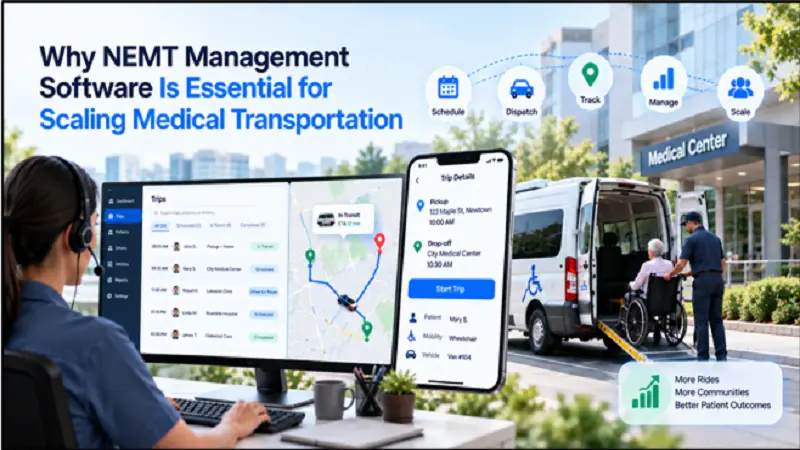
Every NEMT business plans for more vehicles and more contracts. Few plan for what that growth actually demands from their systems. A process that works cleanly for ten vehicles does not simply do more work at thirty vehicles. It starts failing in ways that were never a problem before, because the systems underneath were never built to carry that much coordination.
Dispatchers who once tracked every driver from memory now lose track of who is available and where. Billing that took an afternoon starts taking a week, and disputes with hospital partners become routine instead of rare. None of this happens because a team stopped caring. It happens because the tools they rely on were sized for a smaller business.
This is the point where NEMT management software stops being optional. It is not a convenience feature for businesses that can afford it. It is the infrastructure that lets a fleet scale cleanly instead of scaling into chaos, and the layer that keeps NEMT dispatch software, billing, and fleet tracking working as one system instead of three disconnected habits.
Here is what actually changes once volume rises, and what your systems need to hold up when it does.
What Breaks First When Volume Climbs
Ten vehicles and a shared calendar can work fine for a while. A dispatcher remembers which driver is close to the pharmacy pickup, which van has a wheelchair lift, and which patient always runs five minutes late. That memory holds up until it does not.
Push the same operation to thirty vehicles across five hospital contracts, and the mental math stops working. Trips get assigned twice. A driver waits for a text that never comes because the dispatcher is on another call. A patient sits outside a clinic wondering where their ride went.
None of this shows up because your team stopped caring. It shows up because the system they are working with was never designed to hold that much information at once.
The Coordination Problem Hits Before Anything Else Does
Billing gets attention because it involves money. Compliance gets attention because it involves risk. Coordination usually gets ignored until it fails in front of a hospital partner, and by then the damage is already done.
A single missed pickup early on gets written off as a bad day. The same mistake at fifty trips a day starts looking like a pattern, and hospital administrators do notice patterns. They compare notes with other providers.
What Good NEMT Management Software Actually Changes
This is not about digitizing a paper process and calling it modern. A real system restructures how information moves, so a dispatcher is not the only person holding the full picture in their head.
Trip requests land in one queue instead of multiple threads. Assignments go to the closest available driver automatically. This frees your dispatcher to handle the exceptions that actually need a human. Invoices generate themselves from completed trips instead of waiting for someone to reconstruct a month from memory and a stack of paper.
Four things tend to matter most once a business crosses that growth threshold.
- Trip visibility that everyone can see at once
- Driver matching that runs on real availability
- Billing logic that applies the same way every time
- Reporting that actually surfaces patterns
Manual Process vs. NEMT Management Software Dispatch Alone Will Not Carry A Growing Fleet
NEMT dispatch software is usually the first thing providers invest in, and that makes sense. Getting a driver to a patient on time is the whole job.
But a provider can nail dispatch and still bleed money on inconsistent billing. They can run every trip on time and still frustrate a hospital partner who has no visibility into where their patients are. Management software takes dispatch and connects it to everything else the business needs to function at a larger scale.
Scheduling Gets Harder Faster Than Most Providers Expect
Doubling your fleet does not double your scheduling complexity. It multiplies it, because every new vehicle interacts with every trip, driver, and appointment window already on the calendar.
NEMT scheduling software built for this handles recurring appointments without someone rebuilding them by hand every week. A dialysis patient with a standing Tuesday and Thursday ride should be a five-second confirmation, not a fresh booking each time.
Recurring patients are common in this business, often more common than one-time riders. Treating every one of them like a new booking wastes hours your team does not have.
Fleet Visibility Stops Being Optional At A Certain Size
Small fleets run on memory. A dispatcher knows the blue van has a transmission problem and the driver on route 4 called in sick. That works right up until it does not, usually around the same point coordination starts to strain.
NEMT vehicle scheduling software keeps every vehicle’s status, availability, and maintenance record visible without anyone needing to ask around first. Assigning a trip to a van that will not be road-ready until Thursday is a mistake that only happens when fleet data lives in someone’s head instead of a screen.
Picture a provider running twenty-two vehicles across two counties. One van goes into the shop Monday morning for a brake repair that is expected to take two days. Without live fleet status, that van still shows as available in the dispatch queue. A dispatcher assigns it to a Wednesday morning dialysis pickup, and the patient is left waiting outside their clinic while someone scrambles to find a backup vehicle. With real-time fleet visibility, that van would have shown as unavailable from the moment it entered the shop, and the trip would have gone to a different driver automatically.
It also costs money in a quieter way. A van sitting idle without a documented reason is a van not generating revenue.
Hospital Partners Judge You Differently As Volume Rises
A single missed pickup early in a partnership gets forgiven. The same mistake once you are running fifty trips a week for that hospital reads as a reliability problem, and reliability problems get discussed at the next vendor review.
NEMT transportation software built for scale gives your provider partners a dashboard of their own, where they can book, track, and pay without calling your office every time. That kind of access signals that your business has grown up, and hospital administrators tend to notice the difference immediately.
Would your current setup hold up if one partner doubled their trip volume next month? Some providers know the answer right away. Others realize they do not, which is usually the moment they start looking for something better.
Compliance Gets Harder To Retrofit The Bigger You Get
More trips mean more protected health information moving through your systems every day. Compliance that felt manageable with a handful of vehicles needs real infrastructure once that volume climbs.
Software built with HIPAA compliance in mind treats encryption, access controls, and audit trails as standard. Fixing compliance after a data incident costs far more, in money and in trust, than building on solid ground from day one.
A Few Signs The Old System Has Already Run Its Course
Two or three of these showing up in the same month usually means the cost of staying manual has already outpaced the cost of switching.
What To Actually Look For When You Are Ready To Upgrade
Not every NEMT vehicle scheduling software grows well with a business. Some tools that feel perfectly fine at five vehicles turn into a liability at fifty, mostly because they were never built with that scale in mind.
Look for a system that keeps dispatch, scheduling, fleet management, and billing connected rather than bolted together from separate vendors. That connection is what lets a business actually scale, instead of asking your team to manually reconcile four tools that were never meant to talk to each other.
Pricing matters too. A platform priced fairly against your growth lets your software costs rise in step with revenue, not ahead of it.
Conclusion
Scaling a medical transportation business puts pressure on every part of the operation, dispatch, billing, compliance- all at the same time. NEMT management software is what holds those pieces together as volume rises and hospital partners start expecting more.
Providers who invest early tend to skip the painful stretch where growth outpaces what their team can manage by hand. The ones who wait usually find out the hard way, right when they can least afford the disruption.
Mobisoft Infotech builds a cloud-based NEMT platform around exactly this challenge, with dispatch, scheduling, fleet management, and billing working together instead of living in separate silos.
If your current systems are starting to strain, a dedicated NEMT management software solution is worth a look before the next growth spurt arrives.