
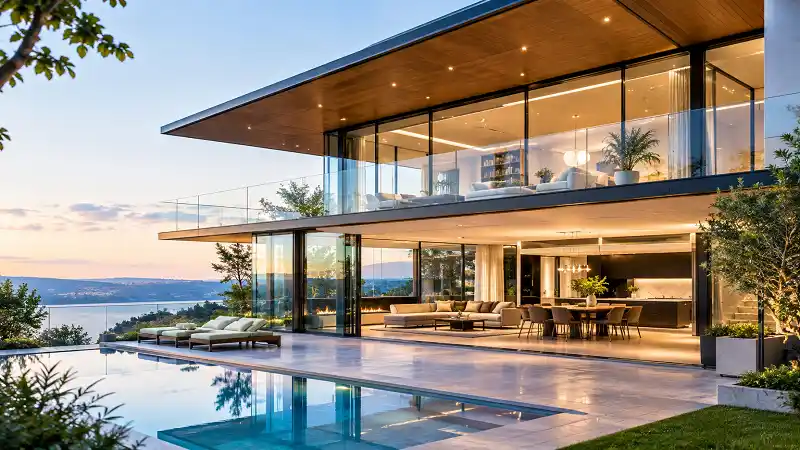
Walk into a room that’s been built around natural light, and you’ll notice it straight away. Ceilings look taller. The garden pulls closer. That hard line between inside and outside just sort of dissolves, and the whole space breathes differently because of it. Floor-to-ceiling glass used to be the obvious answer when architects wanted that effect, and for a long time it worked well enough.
But something interesting has been going on in high-end residential design lately, and it involves materials that most people wouldn’t connect with luxury homes: plastics. Polycarbonate and acrylic are turning up in some of the most ambitious builds around the world, and there are solid reasons why.
Why Architects Are Moving Beyond Glass
Glass has been the default choice for transparency in buildings for as long as anyone can remember. It looks good and clients trust it. But once you start working at a larger scale, the problems become harder to ignore, because big glass panels are seriously heavy and that means beefier structural frames and a lot more steel to hold everything together. They’ll shatter on impact too, which rules them out for exposed roofing or anywhere near a children’s play area. Double-glazed units do a decent job with insulation, sure, but they’re not always the right call for every part of a home.
Polycarbonate comes in at roughly half the weight of glass for equivalent thickness, and you’d have a hard time breaking it even deliberately. Multiwall versions trap air between internal layers, giving them real insulating capability without needing the bulk of a sealed glazing unit on top.
For courtyard canopies, covered walkways, pool enclosures, and similar structures, that combination of lighter weight, serious toughness, built-in thermal performance, and the ability to curve or mould into non-flat shapes has convinced a growing number of architects to choose it over glass, especially when the brief involves wider spans or non-standard geometry.
Real Projects, Real Results
A few of the most impressive examples come from architects who’ve used these materials where nobody expected them. Across London, a growing number of high-end extensions now have polycarbonate roofing over internal courtyards. The result is a flood of diffused, even light that glass just can’t match. Shadows go soft instead of harsh, glare disappears, and the whole room ends up with a quality of light that genuinely transforms the space.
Japanese residential architecture got there first, though. Firms like SANAA have been using sheets of acrylic and polycarbonate to make walls that glow instead of reflect for years now. At night, the homes take on this lantern-like quality that’s completely unlike anything you’d get with glass, and that aesthetic has started filtering into UK design practice as well.
Cast acrylic has found a separate niche inside luxury interiors. Designers pick it for room dividers, staircase balustrades, shelving features, irregular furniture pieces and more. That’s because the optical clarity rivals glass but the material is far easier to shape into custom curves, forms, and non-standard finishes that tempered glass would make prohibitively expensive. Another thing these plastics have going for them is that today, specialist UK suppliers like Simply Plastics offer cut-to-size acrylic and polycarbonate in a range of finishes, which matters a great deal when a project demands exact dimensions and a flawless edge.
What Homeowners Should Know Before Committing
Before going all-in on transparent plastics for a residential project, there are a few things to keep in mind. Acrylic picks up scratches more easily than glass, so it’ll work better in spots where people aren’t brushing past it every day. Polycarbonate holds up better on that front but can yellow over time if you go with a cheaper product. Premium cast acrylic from a reputable manufacturer like Perspex will come with UV-stability guarantees of up to 30 years, and that gap in longevity really does add up.
Most people underestimate how much the finish matters too. A badly cut edge on an acrylic balustrade will catch every light source in the room for all the wrong reasons, and it’ll cheapen the whole look overnight. That’s exactly why architects on these projects tend to source from suppliers who offer diamond polishing, flame polishing, and precision CNC cutting, not generic sheet merchants who can’t deliver that level of detail.
Where Luxury Design Goes From Here
High-end residential architecture has a long history of borrowing materials from places nobody expected. Transparent plastics look like the next chapter in that story. Lighter structures, softer light, superior impact resistance, and far more creative freedom for architects who want to go beyond what glass allows.
As more UK architects gain hands-on experience with polycarbonate and acrylic on residential projects, the range of what’s possible keeps growing. Curved roof panels, backlit feature walls, and full-height translucent facades are already turning up in planning applications that would’ve been glass-only a decade ago. For homeowners who are willing to break with convention, the finished results will do the talking.